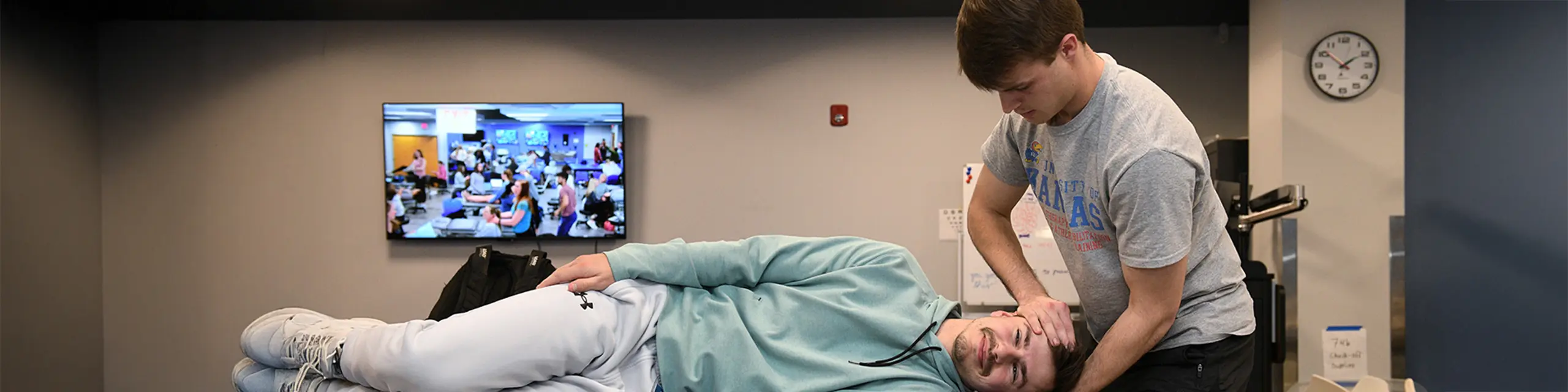
Program Overview
The doctorate in physical therapy at the University of Kansas prepares students to become skilled, compassionate healthcare professionals dedicated to restoring movement, optimizing function, and improving quality of life. Offered through the KU School of Health Professions, this three-year, full-time, on-campus DPT pathway integrates rigorous academic coursework with extensive hands-on clinical education designed to prepare graduates for contemporary practice.
This doctorate in physical therapy curriculum combines foundational sciences, evidence-based practice, and immersive clinical learning to develop physical therapists who are ready to lead in clinical, academic, and research environments. As one of the region’s established physical therapy doctoral programs, the curriculum emphasizes clinical reasoning, patient-centered care, and lifelong learning. Students build advanced knowledge in anatomy, physiology, kinesiology, neuroscience, pathology, pharmacology, and therapeutic interventions through a structured, cohort-based model.
Students in this physical therapy doctorate begin building clinical skills from the start. Integrated clinical experiences begin in the fall semester of year one and continue throughout the first two years, with part-time placements each semester at partner facilities across a range of practice settings and patient populations. In the final year, students complete 36 weeks of full-time clinical rotations at one of more than 250 partner sites across the United States and internationally — including required experiences in both inpatient and outpatient settings. This progression from classroom to clinic, and from observation to practice, is designed to build the clinical reasoning and practical confidence graduates need on day one of their careers.
KU’s DPT program is offered through two distinct learning pathways — on-campus and hybrid — that share the same curriculum, faculty, clinical requirements, and degree. Both are full-time programs completed over nine consecutive semesters, requiring 50–60 hours of study per week, and both enroll up to 60 students per cohort.
On-Campus Pathway
- The on-campus pathway delivers a traditional, immersive learning experience at the KU Medical Center campus in Kansas City, Kansas. Students engage in live lectures, hands-on interactive labs, and simulation-based learning in state-of-the-art facilities, with daily access to faculty and peers. Integrated clinical experiences and structured simulation activities begin early in the program, building toward the full-time clinical year.
Hybrid Pathway
-The hybrid pathway offers a flexible, accessible option for students who need or prefer to learn from a distance. Coursework is delivered through a combination of asynchronous and synchronous online instruction, with one to two intensive on-campus lab immersions per semester at the KU Medical Center campus during the first seven semesters of didactic coursework. Hybrid students complete their integrated clinical experiences at approved sites near their home communities when possible, and complete the same 36-week full-time clinical year as on-campus students. Because the pathway is delivered online, all students, regardless of where they live, pay the same tuition rate.
Both pathways prepare graduates equally for national licensure and entry into the profession. Students select their preferred pathway during the application process and are committed to that pathway upon enrollment.
KU’s DPT program has been continuously accredited by CAPTE since 1944 and consistently ranks among the nation’s top public physical therapy programs according to U.S. News & World Report, with a graduation rate above 98%, a near-perfect ultimate licensure exam pass rate, and a 100% employment rate among recent graduates.
Learn more about KU
Graduate
For more information about the program, visit the program page below.
Physical Therapy, DPTKU School of Health Professions
The Doctorate in Physical Therapy is part of the School of Health Professions, where top-notch training programs and research put our graduates in high demand.Doctorate in Physical Therapy Learning Outcomes
Graduates of the doctorate in physical therapy program will:
- Demonstrate comprehensive knowledge of physical therapy theory, examination, evaluation, diagnosis, prognosis, and intervention
- Integrate foundational sciences with clinical reasoning in patient management
- Assess and treat a wide range of movement dysfunctions and functional limitations
- Apply evidence-based practice principles to clinical decision-making and outcomes assessment
- Communicate effectively with patients, families, and interprofessional healthcare teams
- Exhibit professionalism, ethical decision-making, and leadership consistent with standards of the physical therapy doctoral programs profession
- Promote health, wellness, and injury prevention across diverse populations
What Careers are Possible with a Doctorate in Physical Therapy?
Graduates of KU’s Doctor of Physical Therapy program enter the workforce with strong preparation and strong results. For the most recent reporting periods available:
- Graduation rate: 98.4% (2-year average)
- Ultimate licensure exam pass rate: 99.2%
- Employment rate within two years of passing licensure: 100%
These outcomes reflect graduates who pursue careers across the full spectrum of physical therapy practice — in hospitals, outpatient orthopedic and sports performance clinics, rehabilitation centers, home health agencies, schools, and community health organizations. According to Lightcast labor market data, physical therapists earn a median annual salary of approximately $95,000–$106,000, with strong projected employment growth over the next decade — significantly faster than the national average.
KU graduates benefit from geographic mobility and long-term career stability, and are eligible to apply for licensure in all 50 states, the District of Columbia, Puerto Rico, and the U.S. Virgin Islands.
Tuition and Financial Aid
The Doctorate in Physical Therapy program at KU is affordable, and a range of financial aid options are available. For more information on tuition, financial aid, and graduate assistantships, visit KU Financial Aid?utm_source=degrees-site.Admission Requirements
To apply to the doctorate in physical therapy program at KU, prospective students must:
- Hold a bachelor’s degree from an accredited institution, including official transcripts
- Minimum GPA of 3.0 on a 4.0 scale
- Background check
- Prerequisite courses in basic sciences, mathematics, humanities and social sciences with a grade of “C” or higher on each
- All prerequisite basic science courses must have been completed within the last ten years.
- At least three letters of reference are required; at least one must be from a physical therapist.
- Applicants are expected to possess a general understanding of health care and physical therapy based upon prior employment, observation or volunteer experiences.
- GRE is not required
For additional details, please visit the Department of Physical Therapy, Rehabilitation Science, and Athletic Training.
Student Life and Learning Experiences
Clinical education in KU’s DPT program is structured in two phases. During the first two years, students complete part-time integrated clinical experiences each semester at partnering facilities, translating classroom knowledge into practice across diverse patient populations and settings. These experiences are supported by high-fidelity simulation and interprofessional training events at KU Medical Center’s Health Education Building and Zamierowski Institute for Experiential Learning, and include exposure to tele-rehabilitation through the JaySTART pro bono student-run clinic.
In the final year, students complete 36 weeks of full-time clinical education at one of more than 250 partner sites across the United States and internationally. Clinical placements are based on student preference and site availability, with the program striving to place students in medically underserved communities where possible. All students complete at least nine weeks in an inpatient setting and at least nine weeks in a general or outpatient orthopedic setting, ensuring the broad clinical exposure that prepares a versatile, well-rounded physical therapist.
Hybrid pathway students complete their integrated clinical experiences at approved sites near their home communities when possible, and participate in the same full-time clinical year as on-campus students. All placements across both pathways meet the same program and accreditation standards.
Doctorate in Physical Therapy Sample Courses
Students in this doctorate in physical therapy curriculum complete coursework that integrates theory with applied clinical practice. Examples include:
- Applied Anatomy
- Advanced Topics in Human Anatomy
- Ethics in Health Care
- Cardiopulmonary Physical Therapy
- Neurologic Physical Therapy and Rehabilitation
The curriculum sequence within this physical therapy doctorate progressively builds competencies in examination, intervention, and outcomes evaluation. Graduates consistently demonstrate strong preparation for national licensure examination performance and entry into professional DPT jobs. For a complete list of course offerings and degree requirements, visit the KU Catalog.
Doctorate in Physical Therapy Frequently Asked Questions
When should I apply?
Applications are due Nov. 1.
How long will it take to complete the degree?
Students typically complete this degree in three years.