Program Overview
The aerospace engineering bachelor of science program prepares students to design, analyze, test, and improve aircraft, spacecraft, and advanced aerospace systems used in today’s rapidly evolving global industries. Built on a strong foundation of mathematics, physics, and engineering principles, KU’s aerospace engineering bachelor’s degree emphasizes both theoretical understanding and practical application, equipping graduates to solve complex technical challenges across aviation, space systems, and defense sectors.
Students pursuing an aerospace engineering bachelor’s degree develop a deep understanding of how vehicles move through air and space, how propulsion systems generate thrust, and how structures withstand extreme forces and environments. Coursework integrates aerodynamics, flight mechanics, propulsion, materials, and systems engineering, allowing students to approach engineering problems from a multidisciplinary perspective. This comprehensive preparation is essential for graduates entering professional practice or continuing into advanced study.
As one of the nation’s established aerospace engineering colleges, the program combines classroom instruction with extensive hands-on learning. Laboratory-based courses, computational modeling, and experimental testing allow students to apply theory using modern engineering tools and industry-standard software. Students gain experience working with wind tunnels, propulsion systems, and structural testing methods, reinforcing critical problem-solving and analytical skills.
The aerospace engineering bachelor’s degree curriculum culminates in a senior design experience that mirrors professional engineering practice. Students work in collaborative teams to design, analyze, and present aerospace systems that meet technical, economic, and operational constraints. This capstone experience strengthens communication skills, ethical reasoning, and teamwork; competencies that are highly valued by employers and graduate programs alike.
For students comparing the best colleges for aerospace engineering, KU’s program offers a balance of rigorous academics, applied research opportunities, and experiential learning designed to support long-term career success.
Learn more about KU
Undergraduate
For more information about the program, visit the program page below.
Aerospace Engineering, BSKU School of Engineering
The Bachelor’s in Aerospace Engineering is part of the School of Engineering, where new technologies are developed to solve the problems facing the world.Bachelor’s in Aerospace Engineering Learning Outcomes
Graduates of the aerospace engineering bachelor’s degree program will be able to:
- Apply mathematics, science, and engineering principles to identify, formulate, and solve complex aerospace engineering problems
- Design and evaluate aerospace systems, components, and processes that meet specified performance, safety, and sustainability requirements
- Conduct experiments, analyze and interpret data, and use engineering judgment to draw valid conclusions
- Use modern engineering tools, computational methods, and simulation technologies relevant to aerospace engineering practice
- Function effectively on multidisciplinary teams, demonstrating leadership, collaboration, and professional communication skills
- Recognize ethical, professional, and societal responsibilities and make informed engineering decisions in global contexts
- Engage in continued learning to adapt to emerging technologies and evolving industry needs
These outcomes align with industry expectations and prepare graduates for both immediate employment and advanced study in aerospace and related engineering fields.
What Careers Are Possible with a Bachelor’s in Aerospace Engineering?
Graduates of KU’s aerospace engineering bachelor’s degree are prepared for a wide range of technical and analytical roles across public and private sectors. Career opportunities extend beyond traditional aircraft and spacecraft design to include research, testing, systems integration, and emerging aerospace technologies.
Common career paths include:
- Aerospace Engineer
- Flight Test Engineer
- Structural Analyst
- Stress Analyst
- Propulsion Engineer
- Systems Engineer
- Research and Development Engineer
According to Lightcast, professionals working in aerospace engineering roles earn a median annual salary of approximately $122,000, with strong long-term demand driven by innovation in commercial aviation, national defense, and space exploration. Graduates from the best schools for aerospace engineering are particularly competitive for roles that require advanced analytical skills and interdisciplinary expertise.
Tuition and Financial Aid
Students pursuing an aerospace engineering degree have access to a range of financial support options designed to make an engineering education attainable. These may include merit-based scholarships, need-based grants, federal loans, and work-study opportunities.
Because engineering programs often involve intensive coursework and laboratory experiences, financial planning is an important part of the academic journey. Prospective students are encouraged to explore available funding resources through KU’s Office of Financial Aid and Scholarships.
Admission Requirements
Admission to the aerospace engineering bachelor’s degree at KU requires meeting general university freshman and transfer admission standards. This includes:
Freshmen
- 3.0 GPA on a 4.0 scale
- Demonstrate mathematics preparedness by:
- Obtaining a mathematics ACT score of 22+ (or math SAT score of 540+), OR
- Achieving a B or better in college algebra or a more advanced mathematics course, OR
- Achieving a C or better in a high school calculus course; OR
- Earning credit via IB or AP credit for the above-mentioned courses in accordance with KU placement credit requirements; OR
- Achieving at minimum a qualifying score for MATH 104 on the ALEKS mathematics placement exam.
Transfers
- Earn a grade of C- or better in MATH 125 (Calculus I, or its direct equivalent), AND
- Earn grades of C or better in math, science, and engineering courses applicable to the engineering degree.
For detailed admission requirements, visit the School of Engineering.
Student Life and Learning Experience
Students in the aerospace engineering bachelor’s degree program benefit from a collaborative academic environment that extends learning beyond the classroom. Participation in student organizations, project teams, and design competitions reinforces technical knowledge while building leadership and professional skills.
Opportunities include:
- Membership in professional engineering organizations such as American Institute of Aeronautics and Astronautics
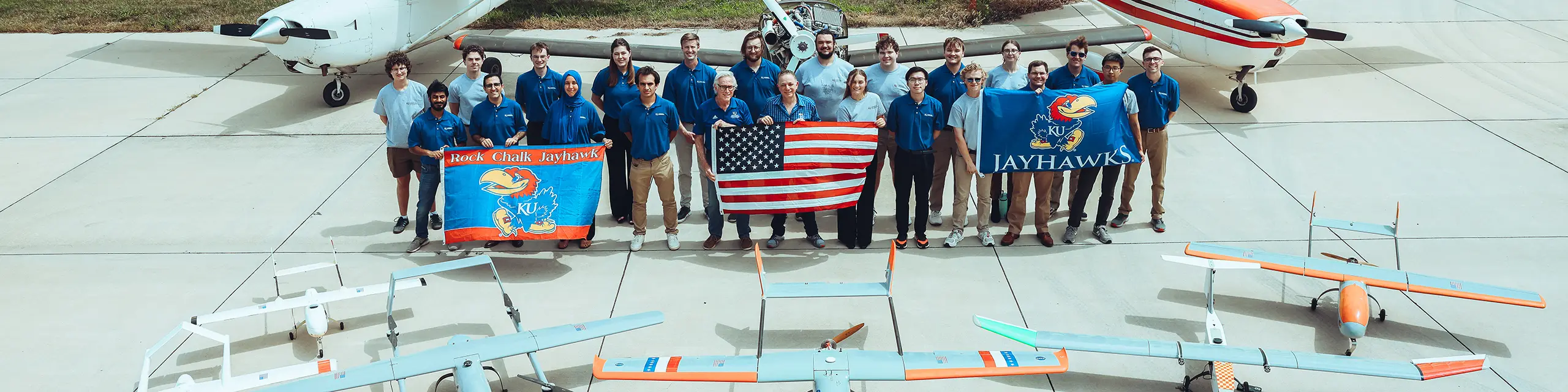
- Participation in hands-on design projects involving rocketry, unmanned aerial vehicles, and aerospace systems
- Undergraduate research experiences with faculty mentors
- Study-abroad programs with a technical or engineering focus
These experiences help distinguish graduates of the best colleges for aerospace engineering by providing practical, real-world context for academic learning.
Bachelor’s in Aerospace Engineering Sample Courses
The aerospace engineering degree requirements include core engineering, mathematics, and physics courses. Sample courses from the curriculum include:
- Introduction to Aerospace Engineering
- Aerospace Systems Design
- Fundamentals of Aerodynamics
- Dynamics of Flight
- Fluid Mechanics
For a complete list of aerospace engineering courses, refer to the KU Catalog.
Bachelor’s in Aerospace Engineering Frequently Asked Questions
When should I apply?
Applications are open and accepted on a rolling basis.
How long will it take to complete the degree?
Students typically complete this degree in four years.
Contact Information
KU School of Engineering studyengineering@ku.edu 785-864-3881Accreditation & Notes
The Aerospace Engineering Bachelor of Science program is accredited by the Engineering Accreditation Commission of ABET, https://www.abet.org, under the commission’s General Criteria and Program Criteria for Aerospace and Similarly Named Engineering Programs.
A Bachelor of Science in Aerospace Engineering is the official degree awarded, and references to “aerospace engineering bachelor’s degree” or similar terms are used for clarity and student understanding.