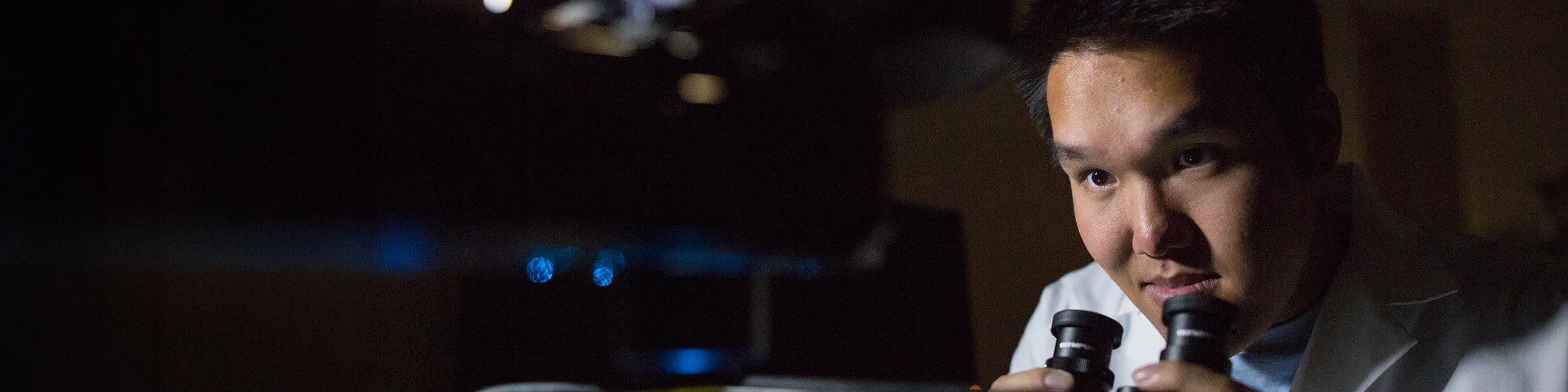
Program Overview
Clinical laboratory scientists, also known as medical laboratory scientists, play a critical role in modern health care by generating laboratory data that informs the diagnosis, treatment, management, and prevention of disease. Working behind the scenes, these professionals analyze blood, tissue, and other biological specimens using advanced instrumentation and established laboratory methods. A clinical laboratory science program prepares students to contribute directly to patient care by ensuring laboratory results are accurate, timely, and clinically meaningful.
At the University of Kansas Medical Center, the clinical laboratory science program is designed to provide a strong foundation in laboratory science while offering focused preparation through two distinct concentrations:
- Clinical Concentration: Prepares students for traditional clinical laboratory roles through hands-on training in hematology, clinical chemistry, microbiology, immunohematology, and immunology within hospital and diagnostic laboratory settings.
- Molecular Biotechnology Concentration: Emphasizes molecular diagnostics and biotechnology techniques used in disease detection, genetic analysis, and biomedical research environments.
Students may pursue either concentration or, with additional coursework, complete both concentrations to broaden their professional skill set. This flexible structure allows students to align their academic path with evolving workforce needs and individual career goals within clinical laboratory science programs.
The curriculum follows a four-year structure. During the first two years, students complete preparatory coursework in biology, chemistry, mathematics, and general education. These foundational studies support the advanced laboratory training that occurs during the final two years, which are completed at the KU Medical Center campus in Kansas City, Kansas. Professional coursework integrates lecture-based instruction with extensive laboratory experience, ensuring students develop both theoretical knowledge and technical proficiency.
Learn more about KU
Undergraduate
For more information about the program, visit the program page below.
Clinical Laboratory Science, BSKU School of Health Professions
The Bachelor’s in Science in Clinical Laboratory Science is part of the School of Health Professions, where top-notch training programs and research put our graduates in high demand.Bachelor’s in Clinical Laboratory Science Learning Outcomes
Graduates of the clinical laboratory science program will be able to:
- Perform clinical laboratory testing with accuracy, precision, and adherence to quality assurance standards.
- Analyze, interpret, and evaluate laboratory data using critical thinking and problem-solving skills.
- Communicate laboratory findings clearly and professionally to health care providers and laboratory colleagues.
- Apply ethical principles, regulatory requirements, and professional standards in all laboratory activities.
- Demonstrate readiness for clinical laboratory scientist certification and ongoing professional development.
What Careers Are Possible With a Bachelor’s in Clinical Laboratory Science
Graduates of the clinical laboratory science program are prepared for a wide range of laboratory-focused roles in health care, research, and industry. Common employment settings include hospitals, reference laboratories, public health agencies, biotechnology companies, and research institutions. Professionals in these roles support diagnostic testing, disease monitoring, quality assurance, and laboratory operations.
According to Lightcast labor market data, demand for laboratory professionals continues to grow due to advances in diagnostic technology, an aging population, and increased reliance on laboratory testing in patient care. Typical clinical laboratory scientist jobs include clinical laboratory scientist, molecular diagnostics technologist, laboratory analyst, and quality assurance specialist.
Tuition and Financial Aid
KU offers a variety of financial aid opportunities to make earning your degree in Clinical Laboratory Science more affordable. Learn more about tuition and funding options at KU Financial Aid.Admission Requirements
Admission into the clinical laboratory science program requires two years of undergraduate study at KU or another institution. Applicants must:
- Earn a 2.7+ college GPA
- Earn a 2.70 or higher GPA in prerequisite science courses, with a minimum grade of C- in each prerequisite course
- Provide official transcripts from all previous institutions
- Provide three letters of recommendation, two of which must be from college science instructors
- Submit a resume
- Complete a personal interview with the admissions committee
- Provide documentation of a shadowing experience
- Successfully complete a background check
For detailed admission requirements, visit KU Admissions.
Student Life and Learning Experience
Students in the clinical laboratory science program benefit from an immersive learning environment that emphasizes hands-on experience and professional mentorship. Clinical rotations provide exposure to real-world laboratory operations and allow students to apply classroom knowledge in supervised settings.
Faculty members are actively engaged in research and clinical practice, offering students insight into current advancements in laboratory science. Opportunities to participate in research projects further enhance technical skills and support exploration of specialized interests within laboratory medicine and biotechnology.
As part of the University of Kansas academic community, students engage with peers and professionals across health disciplines, fostering collaboration and professional growth throughout the program.
Bachelor’s in Clinical Laboratory Science Sample Courses
The curriculum combines scientific theory with applied laboratory practice. Sample courses include:
- Hematology
- Clinical Microbiology
- Clinical Chemistry
- Immunohematology
For a comprehensive list of courses and detailed curriculum information, please refer to the KU Catalog.
Bachelor’s in Clinical Laboratory Science Frequently Asked Questions
When should I apply?
Applications should be submitted by December 15 of the year before the anticipated start date.
How long will it take to complete the degree?
Students typically complete this degree in four years.
Contact Information
Department of Clinical Laboratory Science clsed@kumc.edu 913-588-5220Accreditation & Notes
The Bachelor of Science in Clinical Laboratory Science is accredited by the National Accrediting Agency for Clinical Laboratory Sciences (NAACLS), 5600 N. River Road, Suite 720, Rosemont, IL 60018.
A Bachelor of Science in Clinical Laboratory Science is the official degree awarded. References to “clinical laboratory science program” or similar terms are used for clarity and student understanding.